Do You Have to Be on Camera to Market Your Service Business?
If you’ve spent any time in marketing spaces lately, the message is hard to miss: get on camera, build your personal brand, make yourself the face of your business. The yap challenge is going viral. Founders are being told that talking to their phones is the new content strategy. Attention is currency. Show up or disappear.
If that advice makes you tired just reading it, you’re not behind. You’re just not the audience it was written for.
The Advice Is Real. The Context Is Wrong.
Look at where founder-led marketing content actually comes from. The examples are almost always the same: SaaS CEOs building in public on LinkedIn, course creators whose product is the content itself, DTC brand founders with production teams behind them. The yap challenge that’s going viral right now was built by a creator teaching people how to create content — being on camera constantly is literally what she sells. One piece of research notes that sustainable founder content requires 3–6 hours per week of founder time with a production team handling everything else.
A production team. To handle everything else.
If you run a service business where the product is your expertise and your time is already committed to client delivery, none of these are your context. The advice isn’t wrong. It’s just written for someone else.
Founder-Led vs. Founder-Dominant: What’s the Difference?
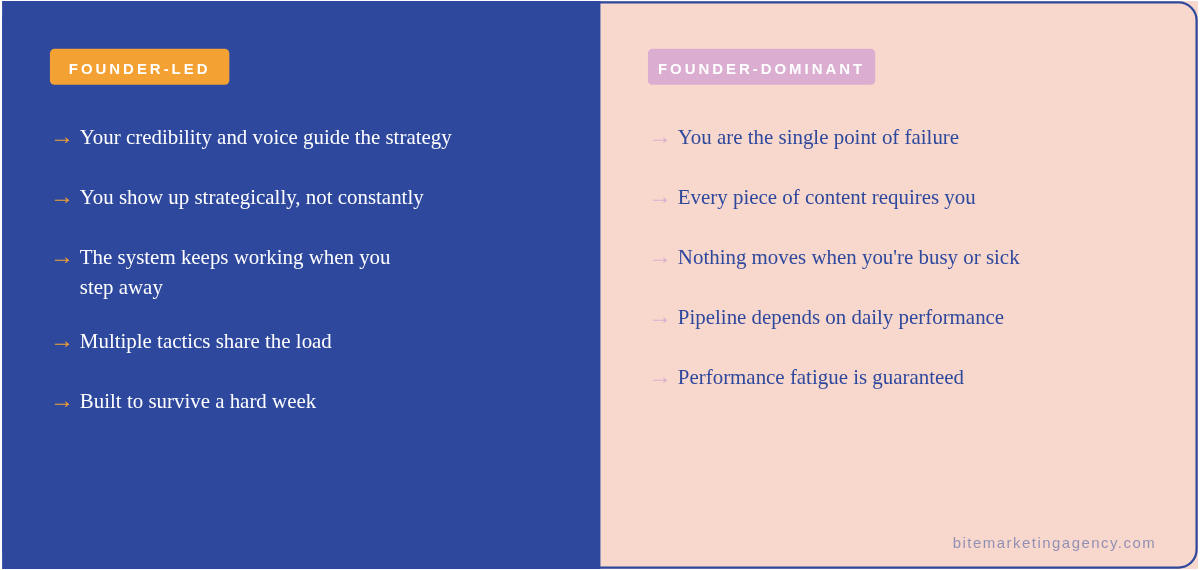
Founder-led marketing, done well, means your credibility, judgment, and voice guide the strategy. You show up where it matters, say things only you can say, and let your expertise do the trust-building work.
Founder-dominant marketing is something different. It means you are the single point of failure. Every piece of content requires you. Nothing moves when you’re busy, sick, fully booked, or just having a regular human week. Your pipeline depends entirely on how consistently you can perform — and performance fatigue is guaranteed.
This is what happens when service business owners follow advice designed for content creators. The creator’s product is the content. Yours is the expertise you deliver to clients. When your marketing eats the same bandwidth you need for client work, something has to give. Usually it’s one or the other, and neither outcome is good.
Why Human Faces Still Matter — And What That Actually Means
Here’s what the “just get off camera” argument misses: the psychology of human faces in marketing is real. People connect with people. A founder who shows up authentically builds trust in a way that polished brand content simply cannot. That part of the conversation is true.
But “human faces work” doesn’t mean your face, every day, on every platform, as the only mechanism your marketing has.
It means your marketing should include human presence — yours, occasionally. A client speaking to her experience. A team member offering a different perspective as you grow. Behind-the-scenes moments that show the real work. A point-of-view piece that could only have been written by someone who has actually done this.
Human presence is an ingredient. It isn’t the whole recipe.
What a Balanced Marketing System Actually Looks Like
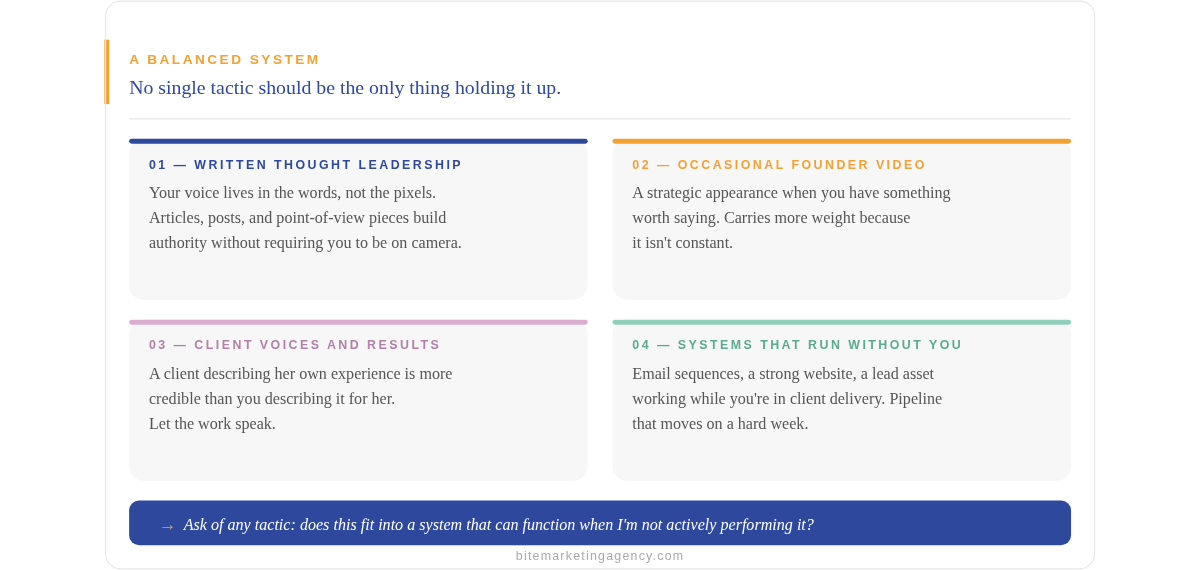
For a service business, the goal is tactic diversity, not tactic dependency. No single piece of your marketing should be the only thing holding the system up — not your face, not one platform, not one type of content.
A few things that work together:
Written thought leadership that demonstrates your expertise without requiring you to be on camera. Your voice lives in the words, not the pixels. A well-argued article or LinkedIn post builds the same trust as a video — often more durably, because it stays findable long after a reel disappears from the feed.
Occasional founder video when you have something worth saying — not as a daily performance, but as a strategic appearance that carries weight because it isn’t constant.
Client voices and results that let the work speak without you narrating it every time. A client describing her own experience is more credible than you describing it for her.
Systems that run without you: email sequences, a strong website, a lead asset that works while you’re in back-to-back client days. These are the pieces that keep your pipeline moving on a hard week — the ones that mean a fully booked month doesn’t also mean a dry pipeline in 90 days.
The question to ask about any tactic isn’t “is this working for other people?” It’s “does this fit into a system that can function when I’m not actively performing it?”
The Real Differentiator for Service Businesses
The reason founder-led marketing works for service businesses isn’t the visibility. It’s the trust. When a potential client reads something you wrote and thinks “this person understands exactly what I’m dealing with,” that has nothing to do with how often you posted or whether you did the challenge. That’s depth of perspective built over time.
That kind of trust is built through quality and consistency — not through daily performance. And it’s built in a lot of ways. On camera is one of them. It isn’t the only one, and for most service business owners, it shouldn’t be the only one.
The founders doing this well aren’t the ones posting the most. They’re the ones who built something that keeps working — whether they’re in it that day or not.
You are the strategy. You are not the content machine.
If you’re ready to build a marketing system that fits how you actually work, explore what working together looks like — or start with a conversation.
Ashley Robinson is the founder of BITE Marketing, a marketing strategy consultancy for established, women-led service businesses. She helps founders build calm, durable marketing systems that grow without the burnout.